
Article I: Name and Purpose
Section 1: Club name
Name of the club – Bajan Land Based Game Fishing CLUB.
( Hereafter called the Club. )
Section 2: Purpose/Mission
To try to foster comradeship amongst its members while exploring new
fishing locations in order to catch fish where no one has caught fish
before. Also, to encourage the development and usage of new
fishing techniques amongst club members.
Our mission is simple, to relax have fun while fishing and to instill deep respect for the environment and to this end we recommend that all club members carry a plastic bag to retain any garbage accumulated. (This club recognises and respects the efforts being made to keep the beaches clean by the National Conservation Commission (NCC), formerly known as the Parks and Beaches Commission which is a quasi-governmental organisation, that was established by an Act of Parliament in 1982. The club will ensure that after all fishing activities the environs are returned to its natural state and void of any litter.
Section 3: Affiliation:
No current affiliations.
Article II: Membership
Section 1a: Eligibility for Membership
The club shall review all submitted membership forms and provide written feedback within three (3) days of receipt. On approval the new member must pay a yearly membership fee as outlined in the approval letter. Acceptance of membership shall be deemed as acceptance of all the Clubs rules. The Club reserves the right to refuse membership at its discretion.The new member without regard to their race, religion, color, sex, age, sexual orientation, or national or ethnic origin will enjoy all the rights, privileges, programs, and other activities, generally accorded or made available to members of the club. Whereas, the club shall reserve the right to allow new members to the club via its WhatsApp Club Chat forum and by extension the club as a whole ONLY when it relates to free club membership but the members in question must fill out a membership application form.
Section 1b: Membership fees
Each
member is charged with paying his or her annual fee of $20.00. In the
case of family membership an additional fee of $5.00 is required
bringing the total to $25.00. The club recognises family membership as -
Married couples (living together) and their children or Spouses (living
together) and their children. The club will not permit a family
membership status that does not include the mother or father. New members must present a picture I.d when paying their membership fees.
Section 2: Voting Member Criteria
To vote on issues pertaining to the Club, members must attend at least six outings (meetings, events, etc.) of the club every year.
Section 3: Removal of Members
Officers of the group discuss the conduct of the member and vote to dismiss or not accordingly. A two-thirds vote is required to dismiss. In the case of a tie, the president’s executive power is exercised.
Section 4: Cancellation of Membership
Members
may at any time cancel their membership either in writing or verbal.
Cessation of club membership may also be given by the club in writing
and signed by the President and any club officer.
*********************************************************
Article III: Officers
Section 1: Officer Qualifications
Active member for at least one year.
Section 2: Elected Officers
President, Vice-President, Secretary, Treasurer, Conservation/Contacts Manager, Volunteer/Service Coordinator
Section 3: Duties of Officers
Preside at activities and events coordinated by club, and conduct themselves in accordance with values of Club.
Typical duties include:
President: Preside at meetings, call special meetings, primary contact with the institutions, appoint committee chairs, runs the election process, appoint either First or Second Vice President to act as President during absence of 3 weeks or more, approval of all spending, overall management of the club, Manage Club's website, other
First Vice President: Assume President’s duties in his/her absence for any 3 week absence or more as directed by President,
schedule meeting/practice rooms/facilities, primary contact of the club, plans member/officer training programs, other
Second Vice President: Assume President’s duties in his/her absence for any 3 week absence or more as directed by President, schedule meeting/practice rooms/facilities, primary contact of the club, plans member/officer training programs, other
Secretary: Takes and distributes minutes of all club meetings, recorder keeper (current and past members, files minutes, etc), club historian, notify members of meetings, handles the official correspondence of the club, other
Treasurer: Keeps all financial records, record picture I.d number of new member when taking annual membership fee, submits monthly audit
statements to President by sixth day of following month, notifies the club of financial issues,
prepares budget/allocation requests for fishing equipment to President
Site planning Manager: Works closely with environmental
issues, also sourcing information and coordinating
club fishing trips.
Coordinator: Handles service orientated responsibilities and activities involving coordinating members availability to attend fishing events.
Section 4: Vacancy in Office
If the President is unable for any reason to continue as President, the vice-president will assume his/her duties. A new Vice President will then be elected. If the Vice President position is vacant, then one of the current officers will simply take over the role. In the case of a vacancy in any other position besides President and Vice President, all active members of the club will be asked to run and voting will take place (paper and/or electronically). All members who have attended at least five meetings per year can vote, with the new officer becoming the person who gets the majority of the votes. In the case of a tie, the current officers will vote, with the President having the final say. If no active members fulfill the positions, the current officers will take over the role.
Section 5: Removal of Officers
To remove an officer the following must happen:
A petition to remove the officer in question must be submitted to the President or the highest officer not in question. This petition for removal must contain the signatures of at least 2 members with active (5 meetings a year) status. When such petition is received, the highest presiding officer not in question shall call a meeting of the club officers other than the officer in question, to determine whether or not the officer should be removed. A majority vote is required for removal. In case of tie, the President, or the highest officer not in question is the determining factor.
Section 6: Appeal of Removal of Officers
The removed officer must write a petition within two weeks stating why the club should consider reinstating him/her as an officer with evidence supporting his/her cause with signatures from 3 active club members. The officers vote to reinstate the officer, with a majority winning. In the case of a tie, the President or the highest ranking officer not in question will be the tie breaker.
**********************************************************
Article IV: Elections
Section 1: Nomination Process
Those seeking nomination must campaign for their respective officer position. Those campaigning must state their plans in the officer position to the club by March 1.
Section 2: Election
The voting members of the club will vote during the end of March for each respective position, the majority vote for each position wins. If there is a tie in voting, the current officers are the tie breakers. If there still is a tie, the President has the final decision. Voting shall be done in secret. All elected officers will serve for one year.
Section 3: Special Elections
In the case an elected position is not filled, a petition will be sent out to active club members. If people respond, the officers will vote with the majority winning. If there is a tie, the President has the last say. If no one responds, the current officers will resume the duties of the missing position.
*********************************************************
Article V: Meetings
Section 1: Regular Meeting/Club Activities
Club meetings will be held regularly at a location/time determined by the members of the Club. Other regular fishing related activities will take place according to schedule or as necessary. The season will conclude with a special, end of year banquet. Members will be notified of meetings via e-mail and word of mouth.
Section 2: Special Meetings
Special meetings will be called by the highest ranking officer. Members of the Club will be notified of special meetings by e-mail and word of mouth. Special meetings most importantly address the issue at hand.
Section 3: Parliamentary Authority
The highest ranking officer will open the meeting, discuss orders of business pertaining to the Club. Then each remaining officer in chain of command order will have an opportunity to speak. Finally, any remaining member will have a chance to have his/her voice heard.
Section 4: Quorum*
Two-thirds of officers must be present for official club business to occur.
********************************************************
Article VI: Committees
Section 1: Committee Structure
Committee shall be determined upon importance/need of the group by the group.
Section 2: Special/Ad-Hoc Committees
Special committees will too be determined by the importance/need of the group.
*******************************************************
Article VII: Finances
Section 1: Funding Committee
Yes, our Club will approach business houses for sponsorship to fund club equipment. All funds obtained must appear in financial records kept by Treasurer.
Section 2: Honorariums
No pay or stipend is received.
Section 3: Dues (optional)
There is no mandatory due for the club.
Section 4: Financial Year
The Club financial year shall be from 1st March to last day of February. A statement of accounts, which have been independently audited, shall be presented to the members prior to the A.G.M.
******************************************************
Article VIII: Amendments
Section 1: Ratification
In order to purpose a club rule amendment a statement with at least 2 active (5 meetings a year) club signatures must be presented to the highest ranking club officer with the criteria for the new amendment. Then, the club officers must create a new amendment accordingly to be ratified by a two-thirds of the officers.
To change a club rule amendment a statement with at least 2 active signatures must be presented to the highest ranking club officer with reason why the amendment must be changed. Then, the officers will vote and a two-thirds vote will change the amendment.
*********************************************************
Article IX: Hazing
The Club considers
hazing to be a degrading and destructive activity which is inconsistent
with the standards of this club. The Fishing Club
recognizes the dignity of every person and opposes all forms of hazing.
Persons found guilty of such will be warned of their offense and or
disciplinary action taken.
What is hazing:
Hazing is any action or situation, with or without the consent of the participants, which recklessly, intentionally, or unintentionally endangers the mental, physical, or spiritual heath or safety of a person.
This includes, but is not limited to any situation which:
• Creates a risk of injury to any individual or group
• Causes discomfort to any individual or group
• Causes embarrassment to any individual or group
• Involves harassment of any individual or group
• Cursing an individual or group to bring about humiliation
• Involves degradation of any individual or group
• Involves ridicule of an individual or group
• Involves or includes the willful destruction or removal of public or
private property for the purpose of initiation or admission into, affiliation
with, or as a condition for continued membership in an organization
Article X: Weapons
Knives and other fishing tools are allowed
however, spearguns are not allowed. Under no circumstances are
unlicensed firearms permitted. Persons found to be carrying a firearm
may be challenged to produce their license, failure to produce same will
result in their expulsion from the club by the President. The club has a
zero tolerance for illegal firearms.
Article XI: Equipment / Angling Regulations
Section 1: Equipment Regulations
A. LINE
1. Monofilament, braid and dacron lines may be used.
2. Wire lines are prohibited.
B. LEADER
The use of a leader is not mandatory. If one is used, it must meet the following specifications:
The length of the leader is the overall length including any lure, hook arrangement or other device, and is measured to the bend of the last hook. The leader must be connected to the line with a snap, knot, splice, swivel or other device. There are no regulations regarding the material or strength of the leader.
In
all line classes up to and including 20 lb (10 kg), the leader shall be
limited to 15 feet (4.57 meters).
The leader on all classes of tackle over 20 lb (10 kg) shall be limited to 30 feet (9.14 meters)
C. ROD
1.
Rods must comply with sporting ethics and customs therefore the club
gives considerable
latitude in allowing anglers in selecting a rod or rods of choice.
Indeed, the market offers several types of casting, spinning and surf
rods from which selection can be made.
2. Rods that are rated over 150 lbs line test will not be recognised by the club and are prohibited. Any fish caught using a rod with such ratings will not be recognised by the club.
3. A maximum of 3 rods can be used by each member during competitions.
D. REEL
1. Reels must comply with sporting ethics and customs. Indeed, the market offers several types of reels baitcasting, spinning and conventional reels from which selection can be made.
2. Power driven reels of any kind are prohibited. This includes motor, hydraulic, or electrically driven reels, and any device that gives the angler an unfair advantage.
E. HOOKS FOR BAIT FISHING
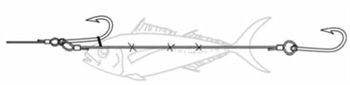
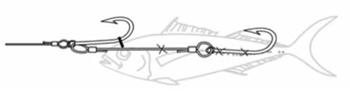
1. For live or dead bait fishing no more than two single hooks may be used. Both must be firmly embedded in or securely attached to the bait. The eyes of the hooks must be no less than a hook's length (the length of the largest hook used) apart and no more than 18 inches (45.72 cm) apart. The only exception is that the point of one hook may be passed through the eye of the other hook.
A hook may not precede bait, lure or bait/lure combo by more than one hook’s length.
2. The use of a dangling or swinging hook is prohibited. Double or treble hooks are prohibited.
3. A two hook rig for bottom fishing is acceptable if it consists of two single hooks on separate leaders or drops. Both hooks must be imbedded in the respective baits and separated sufficiently so that a fish caught on one hook cannot be foul hooked by the other.
4. A photograph or sketch of the hook arrangement must accompany all record applications made for fish caught on two-hook tackle.
F. HOOKS AND LURES
1. When using an artificial lure with a skirt or trailing material, no more than two single hooks may be attached to the line, leader, or trace. The hooks need not be attached separately. The eyes of the hooks must be no less than an overall hook's length (the overall length of the largest hook used) apart and no more than 12 inches (30.48 cm) apart. The only exception is that the point of one hook may be passed through the eye of the other hook. The trailing hook may not extend more than a hook's length beyond the skirt of the lure. A hook may not precede bait, lure or bait/lure combo by more than one hook’s length.. A photograph or sketch showing the hook arrangement must accompany a record application.
2. Gang hooks are permitted when attached to plugs and other artificial lures that are specifically designed for this use. Gang hooks must be free swinging and shall be limited to a maximum of three hooks (single, double, or treble, or a combination of any three). Baits may not be used with gang hooks. A photograph or sketch of the plug or lure must be submitted with record applications.
G. OTHER EQUIPMENT
1. Gimbals must be free swinging, which includes gimbals that swing in a vertical plane only. Any gimbal that allows the angler to reduce strain or to rest while fighting the fish is prohibited.
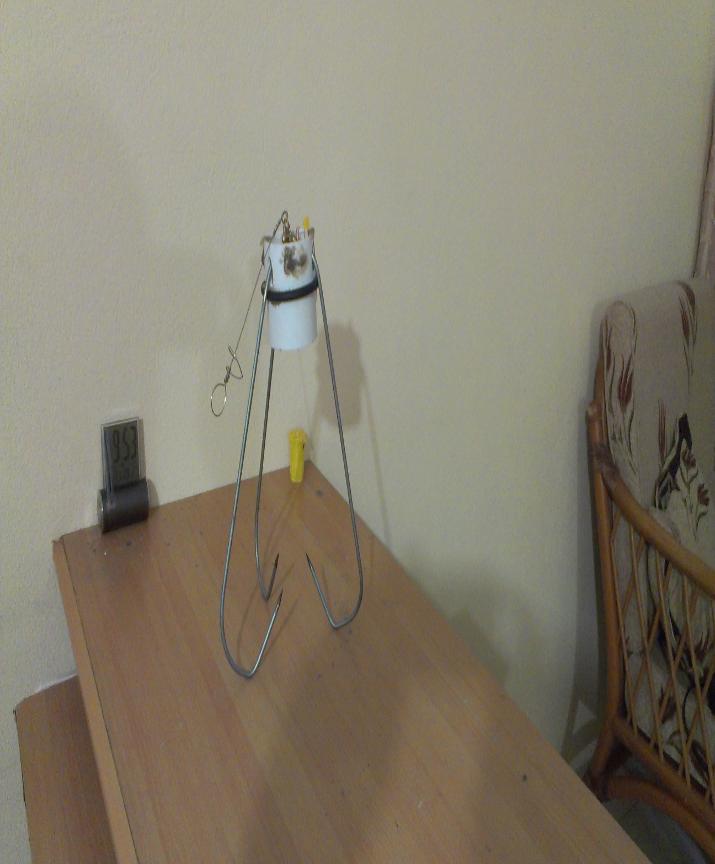
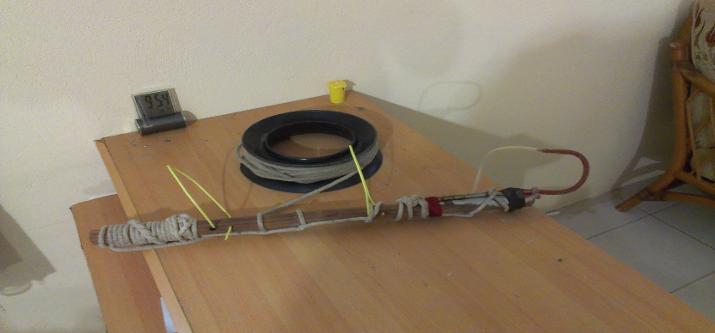
2. Gaffs of varying types are permitted. Harpoons are prohibited and are deemed inappropriate. Only a single hook is permitted on any gaff.
3. Balloons
or other float devices are permitted to be used provided that they do
not act as a buoy to give an unfair advantage to the angler in fighting
or landing the fish. The line must be able to move freely through the
knot or device of the balloon or float.
4. kites
are permitted to be used provided that the actual fishing line is
attached to the snap or other release device, either directly or with
some other material.
5. A safety line may be attached to the rod provided that it does not in any way assist the angler in fighting the fish. The primary use of this safety line is to prevent the rod from being into the sea when not held by the angler.
6. Bite alarms can be fixed to rods or devices allowing wireless communication signaling a bite remotely are permitted. In the case of wireless alarms the club will regulate the assigning of codes, each angler will be assigned 5 codes for his or her personal use. This action will eliminate any interference from similar wireless devices it will also reduce false alarms if the same codes are used by more than one angler. All code records will be kept and maintained by the club.
7. Club Flag should be present and placed in a prominent position in public view when 2 or more club anglers are fishing this is not necessary when fishing from a jetty.
8. First aid kit should be taken on each and every fishing trip.
Section 2: Angling Regulations
1. From the time that a fish strikes or takes a bait or lure, the angler must hook, fight, and land the fish without the aid of any other person, except as provided in these regulations.
2. If a rod holder is used and a fish strikes or takes the bait or lure, the angler must remove the rod from the holder as quickly as possible. The intent of this rule is that the angler shall strike and hook the fish with the rod in hand.
3. In the event of a multiple strike on separate lines being fished by a single angler, only the first fish fought by the angler will be considered for a record.
4. A harness may be attached to the reel or rod. The harness may be replaced or adjusted by a person other than the angler.
5. Use of a rod belt or waist gimbal is permitted.
6.
When angling from a jetty, the rod may be passed to another individual
to avoid obstacles to avoid line from being broken. The other individual
should not fight the fish for more than 5 minutes. In a case where an
individual other than the original angler fighting the fish for more
than 5 minutes the catch if qualifying for a record will not be allowed.
If an individual other than the original angler takes the line from
beyond the rod tip (or plastic fishing reel) while the fish is more than
30 feet away the catch if qualifying for a record will not be allowed.
7.
One or more gaffers may be used in addition to persons holding the
leader or line while the fish is in a vertical position from the angler.
The gaff handle must be in hand when the fish is gaffed or in the case
of a sliding gaff the rope.
8. The angling and equipment regulations shall apply until the fish is weighed.
9. Splicing, removing, or adding to the line while the fish is being played is permitted only if the angler who is fighting the fish maintains control of the main line i.e all helpers must be to the rear of the angler and no other person is permitted between the angler and the fish while this activity is taking place. Contrary to this will result in the catch not qualifying for any records.
10. To qualify for the largest Fish Award ANY FISH caught by an angler must be 4lbs or more.
11. To qualify for the Most Fish award all qualifying fish (1lb or more) angler must catch at least two fish.
Article XII: Catch disqualified from attaining a record
The following acts will disqualify a catch from attaining a record:
1. Failure to comply with equipment or angling regulations.
2.
The act of persons other than the angler in touching any part of the
rod, reel, or line either bodily or with any
device, from the time a fish strikes or takes the bait or lure, until
the fish is either landed or released, or in giving any aid other than
that allowed in the rules and regulations. If an obstacle to the passage
of the line through the rod guides has to be removed from the line,
then the obstacle (whether floatline, sea moss, rubber band, or other
material) shall be held and cut free. Under no circumstances should the
line be held or touched by anyone other than the angler during this
process and will only be permissible under Angling Regulation number 9 above.
3.Harpooning any fish to allow a catch.
4.
In the event that the angler is not at the front working the fish when
splicing, removing, or adding to the line is occurring or allows someone
to touch the line ahead of him while fighting the fish.
5. Attaching the angler's line or leader to a structure or any other object for the purpose of holding or lifting the fish.
6. If a fish escapes before gaffing or netting and is recaptured by any method other than as outlined in the angling rules.
7. When a fish is hooked or entangled on more than one line.
8. The following fish caught will not be considered for any records or recognised by the club for recording purposes: Tarpons, Conger eels or other forms of eels, Manta rays, Skeetes and remora fish.
All fish caught and
landed (with the exception of those fish identified by the club) will be credited to the angler however, to claim a record the
above regulations and rules must be met. In addition all fish caught by an angler and being a member of the club is allowed to have a picture of his or her catch published in their respective album on the clubs website only if the picture is taken with their catch.
Illustrated Guide to Hook Regulations
(Natural Baits and Artificial)
|
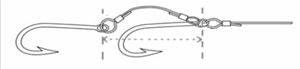
LEGAL if eyes of hooks no more than 18 inches (45.72 cm) apart in baits and no more than 12 inches (30.45 cm) apart in lures. ILLEGAL if eyes further apart than these distances.
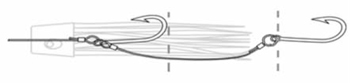
NOT LEGAL as the second or trailing hook extends more than the hook’s length beyond skirt. See also two hook rigs.
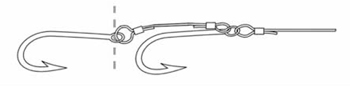
NOT LEGAL in bait or lures as eyes of hooks are less than a hook’s length (the length of the largest hook) apart.
LEGAL as eyes of hooks are no less than a hook’s length apart and no more than 18 inches (45.72 cm) in baits and 12 inches (30.45 cm) in lures.
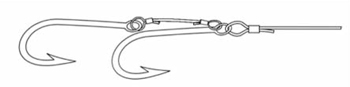
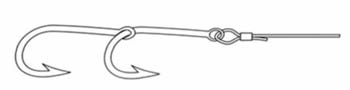
LEGAL in baits and lures. The point of one hook is passed through the eye of the other hook.
|
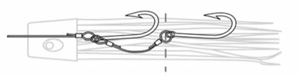
LEGAL as eyes of hooks are no less than a hook’s length apart and no more than 12 inches (30.45 cm) apart, and the trailing hook does not extend more than a hook’s length beyond the skirt.
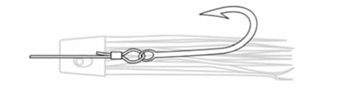
LEGAL as hook is contained within the skirt.
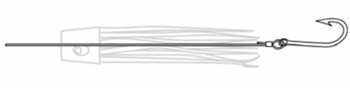
NOT LEGAL as the single hook extends more than its length beyond the skirt.
NOT LEGAL as back hook is not firmly imbedded in or securely attached to bait and is a dangling or swinging hook.
LEGAL as both hooks are firmly imbedded or securely attached to bait. Would not be legal if eyes of hooks were more than 18 inches (45.72 cm) apart
|
GAFFS

LEGAL if effective rope length does not exceed 30 feet (9.15 meters).

LEGAL if effective rope length does not exceed 30 feet (9.15 meters).
Gavel Banging Sound Effect.mp3
